My JENIUS Experience
The Email That Woke Me Up
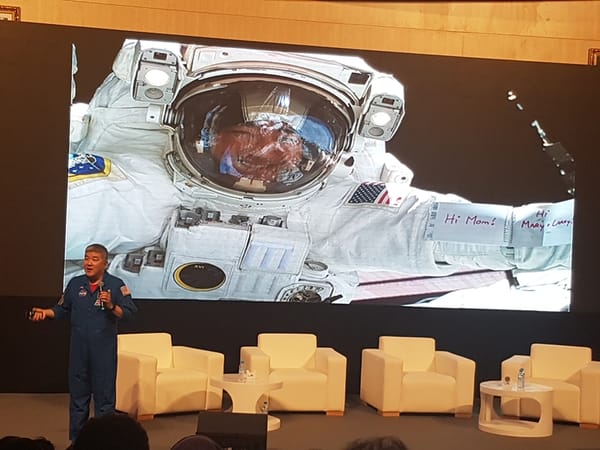
If you've read my post about the NASA Space Apps Challenge, you might remember me briefly mentioning a second hackathon experience. I promised it deserved its own story. Well, here it is.
But let me be upfront: this one hit differently. Not because it was bigger or more prestigious, but because of when it happened in my life and what it meant for my career.
At that point, I was assigned to a project that wasn't exactly setting my soul on fire. I had been on it long enough that my daily tasks had become almost automatic, running on muscle memory. I had coached my team so well that they were nailing the work without me having to hold anyone's hand anymore. Which sounds like a win, and it was, except it left me with a very uncomfortable feeling: boredom. And I still had to be physically present on site every single day.
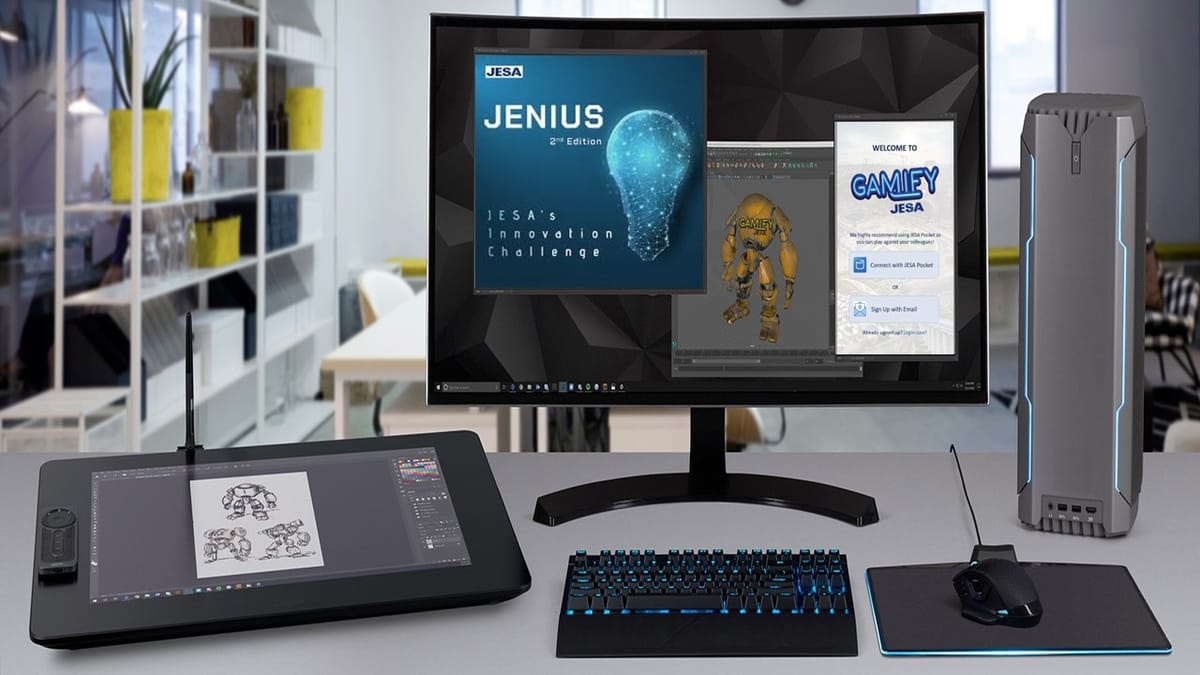
One day, sitting there with my laptop open, I was scrolling through my emails looking for literally anything to break the monotony. That's when a new email popped into my feed: "Submit your idea before October 15th - JENIUS, 2nd Edition."
I won't lie, I reacted like someone who just found water in a desert. This. This is exactly what I need right now.
I opened the submission form and suddenly my brain, which had been running on idle for weeks, came back to life all at once. Should I propose something related to HSE? Green energy, maybe? The ideas were flooding in faster than I could process them. Then, out of nowhere, a memory surfaced, the Space Apps Challenge, the NASA hackathon mentors, and those video game developers who completely rewired how I thought about games as a medium. And just like that, it hit me.
Eureka. I'm making a video game.
I'll be honest with you. JENIUS is organized by JESA, a company that proudly positions itself as the solution company for Africa, and it lives up to that. I knew the caliber of the experts around me, I could already picture the level of the jury, and showing up to that with a video game idea felt, even at the form filling stage, a little like bluffing. But honestly? I didn't care. That's what my heart wanted, and I've learned to trust that feeling.
I had three motivation motors pushing me forward.
The first was redemption: I still carried the weight of everything that went wrong at the Space Apps Challenge, the failed pitch, the communication breakdown, the lessons I never got to apply. This was my chance to settle that score with myself.
The second was the hunger to learn: to stretch my brain past its comfortable limits again, to pick up something genuinely new, to feel that friction of not knowing what you're doing yet.
The third, and the one that excited me most, was incubating my idea: finally having a real platform to develop my game, to work on something challenging, valuable, and actually engaging. The thing I had been desperately missing on that site.
First, Unlearn Everything: Think Like a Jury, Not an Inventor
It all started before any pitching or competing. JENIUS kicked off with a series of sessions and webinars led by international experts, most notably Prof. Emmanuel Josserand, a Professor of Management at EMLV Paris with over 25 years of experience in innovation and entrepreneurship. Not a random guest speaker. The real thing.
The sessions felt like a crash course in turning a raw idea into something credible. And the central lesson echoed something I had already written about in my post on the Space Apps Challenge: it doesn't matter how good your idea is if you can't express it properly.
But this time, we went deeper than that. Because the real problem with most innovators isn't a lack of creativity, it's ego. We fall in love with our own ideas. We think that because something excites us, it should excite everyone else. We walk into a room ready to defend our brainchild instead of asking the only question that actually matters: does this solve a real problem for the people who would fund it, use it, or build it?
The jury doesn't care how long you've been nurturing your idea. They care whether it answers their needs. And these frameworks exist precisely to force you out of your own head and into theirs.
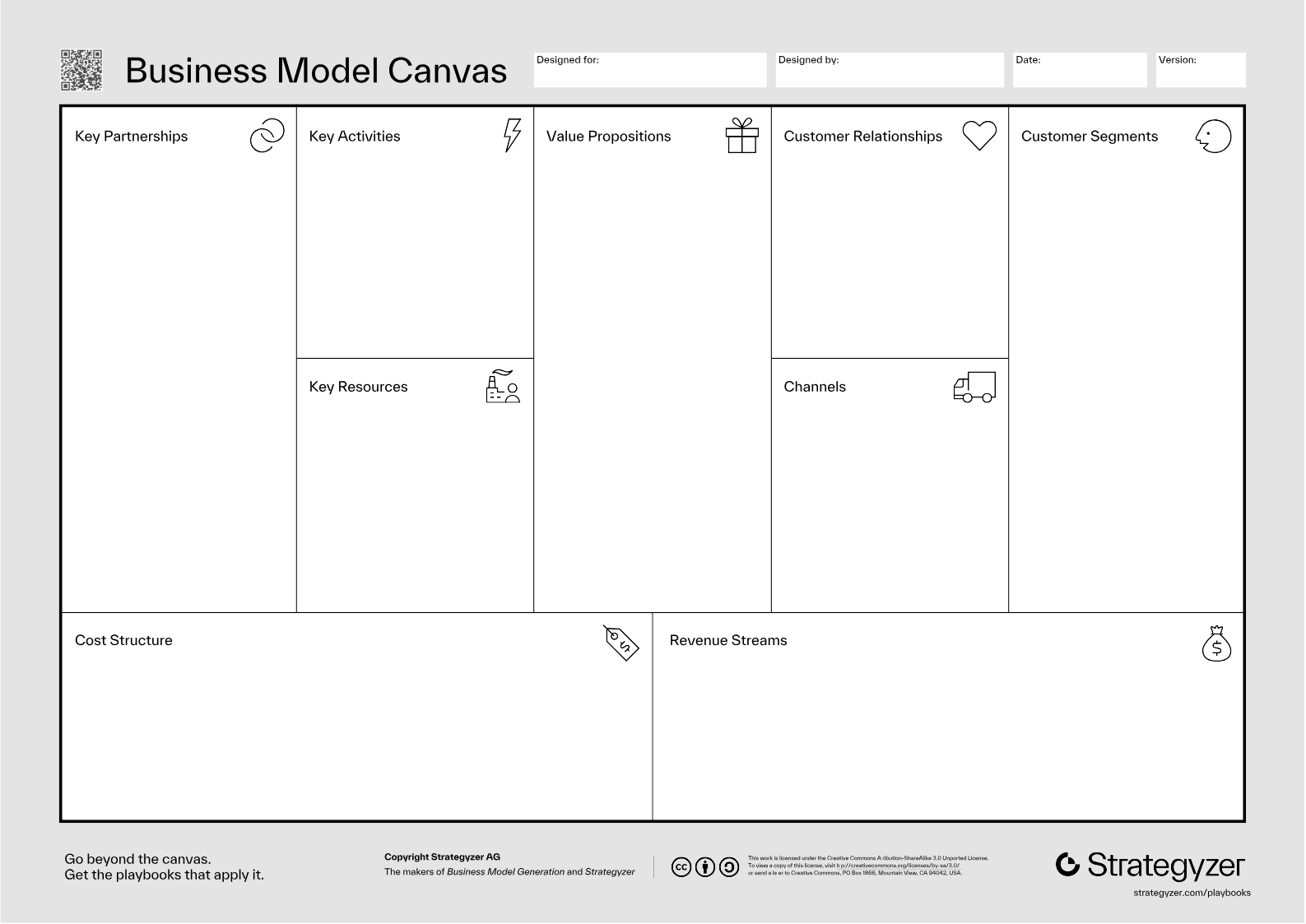
The Business Model Canvas: created by Alex Osterwalder and Yves Pigneur at Strategyzer, this is probably the most widely used entrepreneurial tool in the world. It maps your entire business model on a single page across nine building blocks: who your customers are, what value you're offering them, how you reach them, what resources and activities you need, who your partners are, and how money flows in and out. Think of it as the one page story of your idea's entire ecosystem.
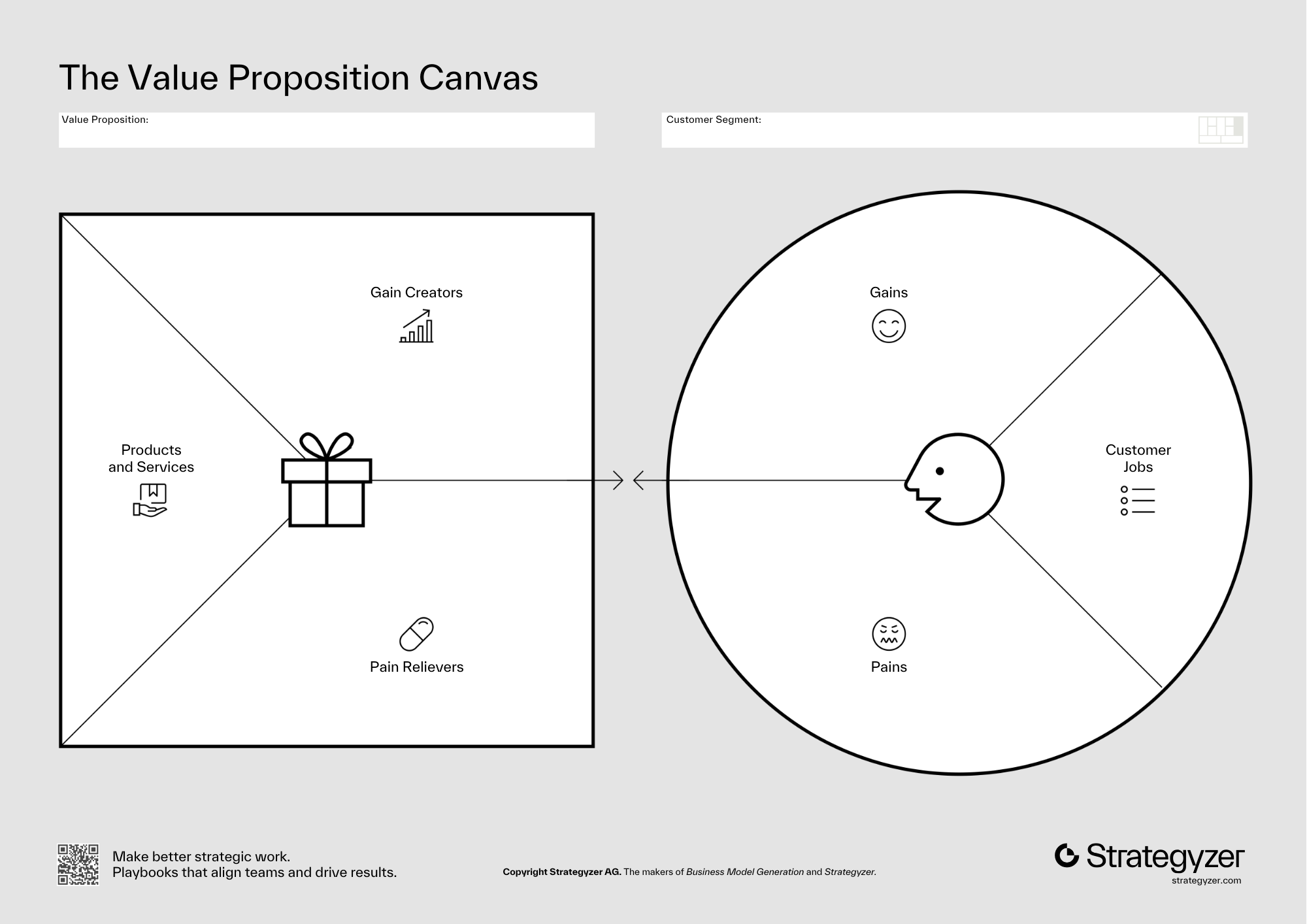
The Value Proposition Canvas: a zoom-in on two of those nine blocks: your value proposition and your customer segment. It helps you answer the only question that actually matters: does what you're building match what your customer genuinely needs? It maps customer pains, gains, and jobs to be done against your products, pain relievers, and gain creators. When the two sides align, you've found your fit.
The Value Curve: borrowed from Blue Ocean Strategy, developed by W. Chan Kim and Renée Mauborgne. It's a visual tool that plots how your idea compares to existing solutions across the factors customers care about. The goal isn't to be slightly better than the competition, it's to draw a completely different curve. To stop fighting in the red ocean of existing solutions and carve your own blue ocean, an uncontested space where you define the rules.
And running through all of it: demand, profitability, feasibility. Because a brilliant idea that nobody needs, can't make money, or can't be built is just a daydream with a fancy name.
This Is What Work Should Feel Like
The JENIUS Camp was the heartbeat of the whole program. Two full days, packed from morning to jury pitches, and I mean packed. If you think a hackathon is just people sitting quietly behind laptops, think again.
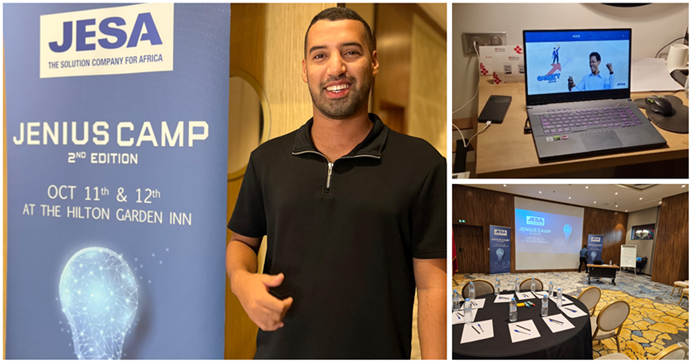
Participants were grouped into four tracks: Delivery, Digital & AI, Tech & Safety, and Sustainability. I was in Digital & AI, which meant my adversaries were also my closest mirrors, people obsessing over the same space I was playing in, with different angles and different blind spots.
And here's something nobody tells you going in: learning about your peers' ideas is just as valuable as developing your own. Some of my best feedback didn't come from the mentors, it came from the competitors sitting across the table. Collaborating with your adversaries isn't weakness. It's one of the smartest moves you can make in a room like that.
The mentors weren't consultants reading from slides. These were entrepreneurs who had actually built things, who knew what it felt like to hit a wall with a half finished product and a deadline breathing down their neck. That's a different kind of knowledge, you can feel it when someone speaks from experience versus from a textbook.
And that experience showed in the feedback. Remember those canvases we talked about earlier? This is where they stopped being theory. You're sitting there with a game idea you've never built, in front of people who have, and they're asking you: how does it make money? Subscriptions? In-app ads? One time licenses? Which market are you targeting first and why? What skills do you need to develop it and do you have access to them? What certifications or licenses does your product require to operate? These aren't hostile questions, they're the exact questions a jury will fire at you. The mentors had been on both sides of that table, and they were essentially handing you the answers before the exam.
One moment that stuck with me was when the camp organizer shared something personal. He had left a position at one of the best companies in the world to pursue what he loved and build a living out of it. Getting money from what you love, not the other way around. Every entrepreneur mentor in that room had made the same bet on themselves at some point. Some had patented entire processes and licensed them to companies, the kind of move that changes your financial life entirely. I sat there thinking: that's a different kind of freedom.
The expert reviews were unfiltered and valuable. When one of them looked at my mockup and assumed I was a designer by profession, I won't pretend that didn't feel good.
And above all of it: the Managing Director of JESA himself walked in to genuinely engage with what we were building, idea by idea. When he stopped at mine and shared his thoughts, I felt something I hadn't felt in a long time, that what I was doing mattered. Compare that to the daily grind on site where toxic behaviors are somehow the norm, and you start wondering why we don't design every workplace to feel like this
The Pitch
I'll be honest, I did it again. Another hackathon, another sleepless night. This time I stayed up designing the mockup of my game until it matched exactly what I had in my head. I worked on the hook, the problem statement, the market sizing, a three year roadmap, and a call to action. Ten minutes of material, sharp and ready.
Then, the morning of the pitch, I found out I had five minutes.
Five minutes to present a gaming solution to a jury. Not obvious. Not easy. And learning that last minute wasn't exactly a confidence booster, but I adjusted, cut what I had to cut, and walked in anyway.
The jury was composed mostly of seasoned executives, and explaining the horizons of the video game industry to them was its own challenge. Gaming isn't just entertainment anymore, it's a multi billion dollar ecosystem of education, training, simulation, and engagement. But bridging that gap in five minutes, to an audience not necessarily immersed in that world, requires a different kind of storytelling.
This time though, I was proud of my pitch. Unlike what happened at the Space Apps Challenge, I felt I did my part cleanly. I had the hook, the structure, the energy. I even felt some nerves before going up, which surprised me, given that my job has me speaking in front of hundreds of people on a weekly basis. But this setting was different. It always is when something genuinely matters to you.
I didn't reach the finals. Fair play.
I think my idea was ahead of where the program's focus was at that moment. My call to action aimed to position JESA as a hub for game development, bold, perhaps too bold for a portfolio deeply rooted in engineering and infrastructure. Not a wrong idea, just maybe not the right room for it yet. And that's okay. Sometimes the timing isn't there, and that's nobody's fault.
What I walked away with was something more lasting than a trophy: my self confidence in innovation was fully restored. I left that camp knowing I could generate ideas, structure them, defend them, and inspire people with them. And sure enough, in the months that followed, even more ideas started surfacing, some I've acted on, some still waiting for their moment.